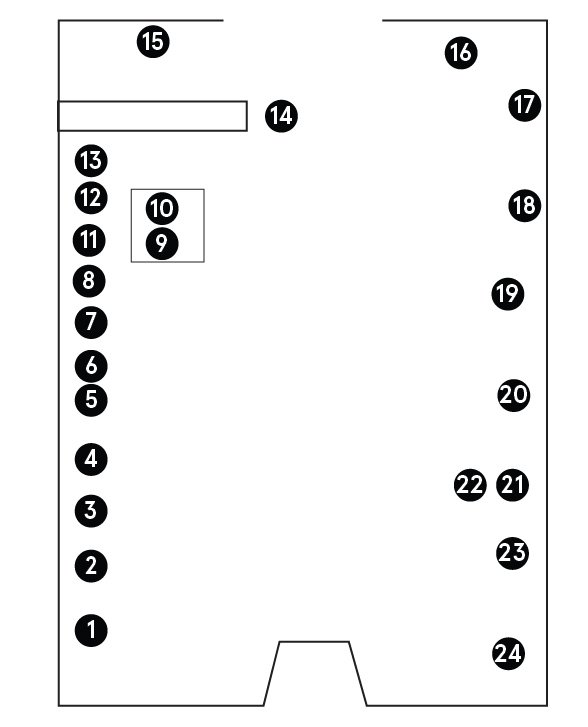
The Game Show, List of Works, Clockwise
+ Artist Biographies and Statements
Performers, Saturday December 20th
-
Samantha Fabrikant (She/Her), is a Pacific Northwest based curator, choreographer, and performer.. Originally from Miami, FL, she began her formal training under the direction of Daniel Lewis at New World School of The Arts. Samantha continued her education in dance through her BFA from The Boston Conservatory and has since worked with choreographers such as Mike Esperanza, Maia Durfee, Sidra Bell, and companies such as The Dash Ensemble, SLOWBURN dance company, The Cunningham Trust, and Ricketysticks Dance Theater among others. As a creator, Samantha’s work has been presented by Boost Dance Festival, Base Arts Space, and Fertile Ground in New York City, and has acted as a curatorial panel member for the Base Arts Space program, 12 Minutes Max. Most recently, Samantha was an artist in residence at the University of Washington’s bodyspacetime creative residency and The Shed Seattle.
This work brings together dance, sculpture, and the imagination to create a shifting landscape of play and physical negotiation. Built from bubble wrap we create a terrain to navigate, disrupt, and reshape. Movement emerges from each interaction between body, material, and space, revealing how touch, pressure, and curiosity can transform a performance in real time. This is an open invitation to step inside and explore the terrain, exploring how shared experimentation can become a form of choreography. At its core, this project expands what dance can be. It is a space for curiosity, play, and co-creation.
-
Dream Balm is the sonic expression of the friendship between Rose Martin and Sophie Chin. Their shared musical practices focus on embodiment, curiosity, intention, and play. Dream Balm explores the intimacy of performance and engages in audience connection through a lens of consent and care. Sharing sound and space is an act of love!
Game Sounds is the codified evolution of an improvisation performed by the duo Dream Balm. Throughout a 30min live performance, Dream Balm crafts a playful and intimate soundscape while following (and breaking) the rules of a dice based game. Those witnessing the game are invited to laugh! In conversation with the work of George Lipsitz and Barbara Tomlinson and their book ‘Insubordinate Spaces,’ this piece creates “new social pathways” by engaging musical and social improvisation and accompaniment, centering play and joy as an act of care. What would have just been a game between friends, Game Sounds is a welcome space for all to experience the play of sound.
Gallery
-
Clara and Caryn find dreamy solutions to quotidian nightmares. Together they have twice as many problems and twice as much fun solving them. Both artists hail from competitive circles and diverge in their approaches to games. Together they have created this guided audio meditation to take game nights from social warzone to cooperative bliss.
Clara Harlow (she/her) is an interdisciplinary artist and educator interested in the question of how we can make today different than yesterday. Her work operates as an invitation into themes of celebration, exchange, and alternative ways of measuring time and value. Through parties, workshops, and interactive objects, Clara is invested in how we can turn the dilemmas of the everyday into an opportunity for experimental problem solving and collective delight. Her practice aims to create responsive public containers for unexpected joy and connection, but if she can just get you to forget about your To Do list for a little while, that’s pretty good too.
Caryn Aasness (they/them) is a queer disabled artist living in Portland, Oregon. Their practice is an exploration of and an outlet for their obsessive compulsive tendencies, their (often bashful) gender-fuckery, and their temptation to cheat at language. Working responsively to place and public, Caryn seeks to identify patterns. Their work is an invitation to stretch a category or collection to its illogical extreme. Caryn has a BFA in Fiber from California State University Long Beach, an MFA in Social Practice from Portland State University, and a snake tattoo.
-
Chroma is a point-and-click puzzle adventure game where painting is play— literally. By learning to wield the magic of color, you unveil mysteries set in its weird, occult world.
With a friendship forged over a decade-plus of tabletop roleplay and dissecting the titles we're currently playing, dreaming up a video game was a natural extension of our explorations in the art of games. This demo features a small slice of our in-progress game exploring color (or its lack-there-of) and its many meanings.
Jay Stoneking is a Seattle artist, designer, and graphic novelist. His creations are both art and occult, drawing inspiration from science, fantasy, and science fiction alongside symbols and forms from modern witchcraft. Briefly a software developer before embarking into a long career as an experience (UX/UI) designer, Stoneking’s creative practice and professional life now spans traditional and digital mediums, illustration, written works, and design of all kinds.
Patricio Legrás is a Seattle based game designer with over a decade experience. He is passionate about game systems, mechanics and player experience. At home, Patricio experiments with what makes games engaging at their core.
-
Candy is universal and international: every country has a favorite packaged sweet and a love of sugary treats. In this political and economic climate, I think “fun” and humor are much needed antidotes – this painting exemplifies a simple commonality. Candy evokes childhood memories (whether rewards, even bribery, or conversely the “forbidden”) in a lot of adults, encouraging playfulness and happiness. This is also a personal theme for me - I always keep candy (only) in my studio as a lure to begin work! There were 50 of these small paintings, when displayed in entirety they were shown with a large canvas floorcloth of Candyland. Enjoy, candy (hopefully) brings out the kid in all of us!
Kelly Lyles : Life (beside politics) is lots of fun, I hope viewers will share that in my work. I’m known equally for painting, Artcars, colourful clothing, and networking for the arts. There’s usually an element of humor, especially in these trying times we need laughter! I’ve had an exciting life, growing up all over the world thanks to a father in the international division of 3M company. I continue to travel regularly and have led 5 International art delegations in the last 5 years, forging alliances in China, Eastern Europe, Cuba, and South Africa for the Cape Town Art Fair. I’m also involved in the ARTCAR movement. We decorate and embellish (painting, sculpting and sometimes welding) our vehicles, so they are rolling canvases of the ultimate ‘public art’. My Leopard Bernstein (named after the famous Composer) has been featured in film, television, and print. Publications include Weird Washington book, The New York Times, Woman’s World, National Geographic Kids, The Travel channel, Discovery, Odyssey Network, HGTV). Currently I drive a beaded artcar TANDA TULA homage to South Africa.
-
My nomadic life has informed a practice inspired by shifting landscapes and cultural fragments. I work across painting and film, exploring connection through editing, layering, and assembling. My process often begins without a fixed point and rarely offers clear answers, but it allows me to trace thoughts and reflect on experience.
Soo Hong is a Seattle-based visual artist born in Seoul, Korea. She holds an MA in Communication Design from Central Saint Martins, London, U.K., and a BA in Furniture & Product Design from Hongik University, Korea. Her work has been shown internationally, earning awards from D&AD, GAP, and the Bellevue Arts Program, and she was a finalist for the Neddy Award. -
Seismic Scores: Tools for Tectonic Thinking is a book of playful instructions intended to encourage tectonic thinking–or thinking like a rock. To be used as dance scores, thought experiments, games, or prompts, each exercise reduces a natural geologic process to its simplest actions. Seismic Scores aims to promote understanding, play, and camaraderie between humans and the non-living, natural world. Much like the games of pretend I played outdoors growing up, Seismic Scores asks its audience to enter an imaginative space in order to momentarily merge seamlessly with the larger forces and bodies at work in the world around you.
Hannah Newman is an interdisciplinary artist mining rocks, information technologies, sculpture, and language for their poetic possibilities. She has exhibited, curated, and collaborated with galleries and artist-run spaces across the U.S. and is a co-founder of the collective WAVE Contemporary and a former member of the artist-run gallery Carnation Contemporary. Based in Portland OR, Newman received a Master of Fine Arts from Oregon College of Art and Craft and a B.S in Ceramics and Fine Arts from Indiana Wesleyan University.
-
This simple deck of cards asks questions about default representation and hierarchy in the United States. The deck was designed between 2017-2019, prior to the mass racial protests of 2020 and the government DEI funding cuts. Since then, it has only gotten more complex and necessary for representation of diverse folks in media, or… anywhere. This deck subtly replaces what is thought of as a “standard (white) deck” with one that speaks more to multitudes and embraces racial and gender diversity.
Visitors may handle cards.
Card decks are available for purchase at beautifulstupidthings.comShannon Miwa is a Seattle based artist and designer. Shannon aims to land her work anywhere within the Venn diagram of beautiful and stupid. She hopes that her work engages folks in more questions than answers.
-
Colossal is the product of a dream. Designed to facilitate both solo and asynchronous group play, it asks players to portray the inhabitants of a seaside community during their annual communion with a giant, mysterious sea creature. Through interactions with an oracle and daily journaling or conversation, players explore their collective unconscious and determine what this ritual means to their character. In the world of Colossal, meaning is derived from randomness.
This edition of Colossal is specific to The Game Show. Visitors are invited to freely handle this material and play the game.
Kay Marlow Allen is a game designer, poet, and publisher based in Massachusetts, on the traditional land of the Massachusett people. They won a 2025 Nonbinary Tabletop Award from Snowbright Studio for their game Nectar, and a 2024 Luminary Grant from Hit Point Press. Through their games, Kay shares the mundanity and the magic of the everyday and creates spaces for resting, reflecting, and connecting. See more at earthlybody.studio.
-
The dialogue between each zine within the game develops a language-game of systemic ponder and speculation. Its virtuality is to call forth the nuance of probability(Anti-Aristotelian logic) which can be harnessed into techne. If installed into a collective thought-form, we can garner different patadigms via philosophical thought experiments and design using the phrase “How if?” e.g., How if we provided everything a home? It takes the form of a mirco-psych(a)osis within the table that is activated through roleplaying.
Visitors can handle game assets.
Take a download card for the audio version of the rules as well.
PATADIGM is an autonomous design milieu based in MKE WI spearheaded by Thomas Krajna(They/Any). We are a collective focusing on the intersection of paradigm shifts and ‘Pataphysics(Science of Imaginary Solutions). As of lately, we are focused on designing ludic things and creating an audio guide for the DOMO PLUUME module.
Collaborators: Skylar Zamzow(He/Him), Joe Zamzow(He/Him), Casey Harrison(She/ They), Lucas Alamo(He/They), Will Drea(He/Him), Anon-ymous(??/??), Coe Douglas(He/Him), Wes Larsen(He/Him), Lindsey Larsen(She/Her), Sally Salkin(She/Her), Marcelo Quesada(He/They), & Connor Mandali(He/They).
-
Monster M.A.S.H. is a video game created within a single HTML file that utilizes HTML, CSS, Javascript, and XML. Despite being a completely imagery-based game with no text, there are no image files referenced by the code. Instead, all visuals are dynamically generated using SVG files, enabling animations and player interactivity to modify what appears on the webpage. The core code remains unchanged throughout gameplay, challenging players to contemplate the role of external interpretation by the browser and viewer perspective. This approach raises questions about digital art's nature and how our interactions transform each piece with every encounter.
Io Blair is a creator of games, maps, and other interactive media. With a background spanning geospatial data, computer science, and ethics, Blair examines how we orient and participate in digital, physical, and moral landscapes. As co-founder of Ctrl Shift, a video game company, Blair creates immersive worlds where players work with real humanitarian data and confront consequential decisions, transforming abstract societal issues into tangible experiences. Through innovative design and ethical storytelling, Blair's work bridges technology and human experience, inviting audiences to engage deeply with complex global challenges in meaningful ways.
-
Vinny Roca’s practice uses the language of digital games to examine how neoliberalism shapes desire, motivation, and affect. Through eerie, game-based encounters with strange forms of labor, Roca creates experiences that feel both familiar and unsettling, revealing the absurd logics of contemporary production. Projects like Slot Waste, Tear Shaped Door, and Come Away With Me invite viewers to dwell within confusion, witness machinic processes, and confront the violence and desire-shaping force of capitalist production. Within The Game Show, his work extends the exhibition’s inquiry games as medium for critical artistic experimentation, pulling apart the form of the game to see what it might reveal to the player.
Vinny Roca is an artist and game designer, and an Assistant Professor of Media Studies at Scripps College in Claremont, CA. He holds an MFA in Media Arts from the University of California, Los Angeles. His award-winning game works have been exhibited nationally and internationally.
-
Instructions for ice-breakers:
Visitors may freely handle this material and play the game.My work weaves through various topics concerning recent technologies, overt activist positions, popular philosophy, and dark comedy. I investigate the ways that these topics overlap for us as we navigate, with limited success, complex political and ethical dilemmas through clumsy interfaces, problematic devices, and faulty systems. These investigations arrive for the viewer in the form of inherently interdisciplinary artworks and curatorial experiments, which provoke questions about how we work toward a more desirable collective future, among the machines, atop a planet in crisis.
Clint Sleeper: I am an educator, a media artist, performer, and maker, whose various pursuits humorously ponder an end to capitalism and seriously consider alternative possibilities for picking up the pieces and moving forward. I have an MFA from Simon Fraser University and I work primarily from North Florida. In addition to works released independently, I collaborate with a handful of artists on noise projects, build large scale installations, curate exhibitions, and make jokes that have been exhibited internationally and live among the slop online. -
Games are some of the first ways that humans learn about traps, deception, and competition. As games and other entertainment evolved into the digital realm, the traps we run into take forms of predatory ads and scams. Growing up as a library kid in the millennial era meant encountering virtual traps, through trading card games and browsing the world wide web. Here I defuse one trap with another: bringing pop-ups out of the internet to render them inert and obscuring a trap within a game to shift the target to the human player.
Valeria Haven Espinal (they/them) is a non-binary queer mixed-media artist born and working in Seattle. Val currently experiments with a focus on the microscopic and continues to develop their practice in the permeable realms of artistic research. As Research Director of the Center on Contemporary Art, they confront the archives of Seattle’s arts history and strive to make research inviting, accessible and collaborative. Their work has been shown in Pacific Northwest galleries The Factory, The Vestibule, Center on Contemporary Art, The Fishbowl, and more.
-
This film follows the metamorphosis of a series of red ceramic vessels as they move from static artworks into dynamic, living material. Repurposed and reimagined, the vessels shed their traditional function and become playful, stackable forms—recalling children’s building blocks that invite touch, collaboration, and shape-shifting. In partnership with the Art Scouts Collective—a group of four artists who are very serious about not being serious—the vessels transform again, becoming catalysts for communal play. Together, the Scouts and the vessels explore how art can continually reinvent itself, shifting across mediums, contexts, and relationships to spark new connections, conversations, and possibilities.
Ahuva s. Zaslavsky lives and works in Portland, Oregon. she is a multimedia artist whose work spans painting, printing, sculpture, and writing. Her art explores the connections between space, memory, and trauma, focusing on how people and places influence one another. She investigates themes of displacement, belonging, and power dynamics, while also examining the cyclical nature of creation and destruction, and the potential for transformation.
Art Scouts Collective is a group of four artists who are very serious about not being serious. They create socially engaged work through playful, participatory projects—often centered around food—seeking to spark connection and conversation. Inspired by the Fluxus movement, projects such as the Cookie Exchange, Fluxus Dinner Series, and 30 Day Picnic open accessible spaces where artists and communities can gather, collaborate, and build meaningful relationships.
-
A coin initiates the ritual: a minor transaction that triggers the machine’s somatic shudder, animating the suspended head - my own, rendered as both effigy and interface. The unstable image is a mnemonic rupture - a site where childhood memory is neither fully performed nor entirely possessed but instead flickers in the interstice between artifact and apparition. Behind this, the hacked Skeever - extracted from the digital echelons of the open world game, Elder Scrolls: Skyrim - materializes as a monumental rat! A rat oscillating between digital beast and sculptural revenant. Echoing the Qarakorshaq of Turkic folklore, this creature is a shadow-dweller, mythic and recursive, haunting the peripheries of recollection. The installation operates as a theatre of phantasms, staging memory as a machinic hallucination and the self as a recursive artifact. Mobilizing the lexicon of games, folkloric monstrosity, and the Gothic, I attempt to fold the past and present into temporal strata through the invocation of sculptural gesture and the residue of a personhood on the edge of forgetting.
Umut Gunduz is a second-generation British-born Turk whose artworks consider the connections between identity, memory, and new technologies. Using game engines, interactive systems, digital spaces, and sculptural gestures, his work is predominantly autobiographical, drawing on his diasporic background and socio-economic status to explore the document as a meaning-making machine. His practice includes mechatronic objects, digital environments, video, performance, and text to form imaginative spaces where memory and identity can be redefined and dispersed as new ontological maps. Umut has had work commissioned by the Turner Contemporary and exhibited in a variety of local galleries and festivals wherever he resides. He has presented his research at institutions such as Goldsmiths (University of London) and the Society for Literature, Science and the Arts (SLSA). -
Instructions:
Arrange the items on the table and observe the results in the projection on the wall. Experimenting with the joystick will also change the design.
“PIPO” is a collaboration with Portland-based fiber artist Amanda Triplett. Play and experimentation is central to both artists’ practices and inspired this interactive work.
Stephanie Krimmel is an experimental and experiential artist exploring concepts of time, scale and human experience in her work. Bridging the digital and physical worlds, she creates installations with physical output (such as printed postcards) of her digital practice.
She earned an art and art history degree from the University of Washington, then pursued a twenty-year career in web site development and UX before returning to fine art. She received an Allied Arts Foundation Award in 2025.
Amanda Triplett is an intermedia artist and arts educator based in Portland. She has worked as an artist in residence at Lewis & Clark College in Portland, OR and the Mary Olson Farm in Auburn, WA.
The artists met at Shift Gallery in Seattle where they are both members and show regularly.
-
Collective Claw is a game, and the goal of the game is determined by you, the audience. By using the crude tool of the claw you can set out on a variety of projects - terraforming, ecological restoration, real estate development, construction, geological exploration, preservation, and more. Who gets to change the earth? Who has access and control over the tools that manipulate land, neighborhoods, and cities. In a place undergoing as much change as Seattle, Collective Claw is a game about agency and physical control of the environment. How will you play?
Chris Copeland is an artist living in Seattle, WA. His projects use kinetic sculpture and drawing to explore the ecological and industrial systems of today. Chris explores industrial agriculture, trees, mass production, ants, bioremediation, and bread in order to unsettle the dichotomy of nature and culture. He has a BFA from Carnegie Mellon School of Art, an Masters in Landscape Architecture from the University of Washington, and has been an artist in residence at the Coalesce Center for Biological Art.
Curtis is an artist based in Seattle, Washington. They received their BFA from Carnegie Mellon University in 2018, with a focus in painting and sculpture, and their Master's in Arts from Columbia University in 2024. Their artistic practice explores human-animal relationships, reproductive labor, and how these topics fit into a world of rapidly evolving technology. Outside of art making, Curtis has worked as an educator in both Seattle and Pittsburgh
-
CONNECTOME is a unique, hands-only VR gaming/immersive art experience. This single-player game is intended to evoke a sense of mystery, awe, and child-like wonder as the player moves slowly through a beautiful minimalistic world, revealing its secrets. At its foundation, CONNECTOME is anchored in dynamic, generative geometric art, built around two simple interactions: “pinch-to-reveal” and “drag-to-connect”. Players begin in a black void and ultimately create a large structure around them as well as open their first door… a portal to the next color-washed room. Each room is anchored by a single, bold color from a vaporwave-inspired palette, paired with an evolving ambient soundtrack.
Grant Hinkson is a multidisciplinary technologist, XR game designer and artist whose career spans design, software development, and music composition. His work often explores the tension between rigid systems and random values, resulting in pieces that, despite their code-based origin, can feel organic in nature. Grant’s first game CONNECTOME was featured as the only VR title at this year’s Seattle Indies Expo, and his projection and plotter based artwork has been seen in numerous galleries/exhibits in the Seattle area, including Passable, Public Display Art, Shine on Seattle, and more.
More on Substack!
-
This exhibit is meant to be interactive! Please work your way through the doors, opening and closing them as you go.
What happens when we expand our idea of numbers to include those that never end? Do they still behave like the finite quantities we use every day? In the late 1800s, mathematician Georg Cantor explored these questions and uncovered truths about infinity so strange that many of his peers rejected them. Hilbert’s Hotel brings to life this concept in a playful, interactive game, inviting visitors to act as General Manager of this wild hotel. The work asks how far our minds and language can stretch to grasp the infinite, and whether it is possible to ever truly “fill” this hotel.
Nate Stemen is a technologist and educator dedicated to making advanced ideas in mathematics, physics, and computer science accessible to all. As a quantum software developer, he builds open-source tools that help bring the next generation of computing technologies to life. His creative practice bridges art and science, using interactivity and play to make complex concepts tangible, fun, and inviting.
-
Viewers are welcome to manipulate and interact with the works.
Space and time fold, unfold, and reconfigure in my memory, and in the viewer’s hands. Fragments of built environments, different scales, times, and uses, appear, disappear. Stairs lead down to the basement of the house I live in, or up to the second floor of my childhood dollhouse. Two of the forms can be temporarily held in the shape of a partial house, the third remains flat.
Lilly Handley is an interdisciplinary artist based in Madison, Wisconsin. She received her MFA from Parsons The New School for Design and her BFA from The Art Institute of Boston at Lesley University. Handley is an Assistant Professor in the Department of Art & Design at the University of Wisconsin-Whitewater. In her work, she uses drawing, sculpture, interactive sculpture, images, sound, and video to look at value, perception, identity, hope, and loss. Handley’s work has been shown in exhibitions both nationally and internationally.
-
The Scroll may feel familiar: as you navigate an endless feed of images, you are challenged to determine what is real from what is artificial. Inspired by Plato’s Cave and early-2010s internet games, this web app invites users to reflect on what we dreamed for the internet, and the reality behind the “shadows” we now view daily on our digital screens.
Kate Andersen is an artist and interdisciplinary designer, whose practice explores patterns of thinking and the systems that shape our minds. Her work is often interactive or utilitarian, encouraging ritual, play, or expression among its audience. Threaded by care for environmental consciousness and careful human experience, her work spans mediums - from ecological architecture on the Oaxacan coast, to bio-ceramic funeral vessels in the US. She holds a BA in Studio Art from Florida State University, and works primarily from the coast of central Florida.
-
Ryan Walters’ work examines the intersections of nostalgia, digital culture, and queerness, focusing on how the internet shapes memory, desire, and self-perception. He draws from memes, screenshots, and other forms of digital debris and translates them into painterly images where humor and melancholy coexist. His paintings reflect the instability of contemporary visual culture, where images constantly circulate, distort, and reappear in new contexts. Through layering, fragmentation, and shifts in scale, Walters studies the tension between sincerity and irony that defines digital life. His practice uses painting to slow down and reconsider the fleeting images that influence queer identity and shared experience.
Ryan Walters is a painter from southern Tennessee and is currently pursuing his MFA in Painting at the University of Washington. His work explores nostalgia, digital culture, and queerness through imagery sourced from online environments. Walters transforms digital fragments into paintings that reflect the humor, ambiguity, and emotional texture of contemporary life. His practice considers how internet imagery shapes identity and memory. He received his BFA from the University of North Alabama before moving to Seattle, where he now lives with his partner and two cats.
-
Morpheus’s Mimic, otherwise perfectly camouflaged, lures you closer with its subtle differences. A curious eye finds it balanced on four insect-like legs, three coins are inlaid in its wooden face. A small instruction manual and a slumbering relic sit atop its face, and below its open drawer reveals rows of teeth. The story of the piece is told through engagement with the items it holds, revealing what seemed to be a simple chest has come to life through the actions of the viewer.
The game can be played with the contents of the piece (pillow, brass relic, teeth). Audience is encouraged to play.
Jade Knox’s practice is guided by the theory of the observer effect – that attention shifts reality. She explores this through multiple mediums, creating works that invite active engagement using texture, color, and forms that interrupt space. Recent exhibitions at the Henry Art Gallery and 4Culture examined the wider narrative Knox’s work inhabits. Morpheus’ Mimic invites the viewer to become an explorer of a part of the world in which that story takes place.
-
Learn about Prime Numbers and More!
This piece is a mathematical puzzle consisting of 100 painted wooden blocks.
Sides 1 & 2: a mathematical visualization of the prime factorization of the first 100 integers, where each block represents a number between 1 and 100. Each symbol represents a prime number. The goal of the puzzle is to place the blocks in the correct order by determining which symbol represents which prime number. Viewers are encouraged to solve the puzzle!
Sides 3 & 4: waveforms from a synthesizer (sine wave, square wave, triangle wave, sawtooth wave) in varying frequencies and amplitudes.
Sides 5 & 6: abstract expressionist colors that form in a rainbow gradient when the blocks are placed in the correct order in a 10 x 10 grid.
Juliet Fiss is a computer scientist and mathematical artist from Kirkland, WA. She has a B.S. in Imaging Science from Rochester Institute of Technology and a Ph.D. In Computer Science & Engineering from the University of Washington. Her paintings are visualizations of algorithms in mathematics and computer science, inspired by her interests in computer vision, signal processing, and quantum computing. Her mathematical paintings are a colorful, tactile medium for expressing mathematical intuition and inspiring a love for math.
-
Erin Quinn uses the language of games to confront extraction, collapse, and complicity. Their nostalgic prins and sculptures invite viewers in before questioning the cost of comfort, the price of progress, and who benefits when systems fail the many. Drawing on board-game structures, Quinn examines the tragedy of the commons and how power rewrites rules to enable environmental crisis. Grounded in research and place, they work with sediment, debris, plastic, and what remains. Through playful yet pointed forms, Quinn makes the invisible visible, treating memory as resistance and asks us all to reflect, reckon, and reconsider the future we are shaping.
Erin Quinn is an intersectional environmentalist, sculptor, and printmaker based in Seattle, Washington. They earned a BFA from Oklahoma State University in 2023, and has since exhibited across the US. Quinn’s practice uses play and naivety to examine late-stage capitalism and its impact on the natural world. Quinn was named the 2023 Outstanding Senior at Oklahoma State University and received the 2024 Momentum Grant from Oklahoma Visual Arts Coalition. Quinn has completed internships at Universal Limited Art Editions (NYC), Zygote Press (OH), and Anderson Ranch (CO), and is currently a fabricator for John Grade Studios.