You’re invited to tea!
Isla Vidal: Unspoken Rites, Saturday October 24th, 3-4pm a sonic room and tea ceremony in Occultus
Exhibition, October 3rd-31st
Opening Reception, Saturday October 3rd, 3-7pm
guest curated by Jay Stoneking
Occultus encompasses artworks that live in the boundary between art and the occult. These pieces ask: At what point does art become ritual or sacred practice? When does the act of creation become a deeper exploration of the mysteries of the cosmos? The work might illuminate or speak to hidden knowledge, play with magical and natural forces, or dream of non-traditional divinities.
This project includes two performances:
Isla Vidal: Unspoken Rites, Saturday October 24th, 3-4pm
Shane Fosse: an american hex , Friday October 30th, 6-7pm, audience participation encouraged
Artists
Nola Avienne is a Seattle-based artist inspired by anatomy, chemistry and earth science. Her work has developed through the investigation and negotiation of the tensions between art and science, chaos and order, humor and discomfort. Avienne works with her own blood, feeling it an honest and powerful material. Blood is a potent substance that resonates more than pigment outside of the context of the body. She works with a medical professional to extract small amounts at a time and is a certified phlebotomist.Nola has an MFA in fibers from the University of Washington and a BFA from Otis Art Institute of Parsons School of Design. She is a recipient of the 4Culture Individual Artist Project Grant and the Artist Trust GAP Grant. Her work is included in the Washington State Art Collection, King County Public Art Collection, City of Sammamish Arts Collection and the Seattle City Light Portable Works Collection.
Skivega
“Skivega” binds the words give and ask. The language of witchcraft is written in offering and sacrifice for blessings, protection, fertility, abundance and maybe a little vengeance. Between blood and moon - transcend, transmute and ascend. The hair comes from multiple donors and is hand-dyed. The technique comes from the traditional Victorian hair wreaths. The text and symbology are drawn from multiple sources over many centuries. The blood of the artist is a potent substance that resonates more than any pigment. I work with a medical professional to extract small amounts at a time and am myself a certified phlebotomist.
The Alchemies - The Standoff / Purifying the Lion
Alchemy combines technical skills and practical experience with spiritual components - the transmutation of the base material into something transcendent through the expression of secret rituals and symbols. I gave careful consideration to the associations made to blood. My interest in decontextualizing this provocative material led to alchemy and mysticism as the appropriate connection between material and imagery. I subtracted and added to centuries of imagery to create my own lexicon of secret translations and transmissions.
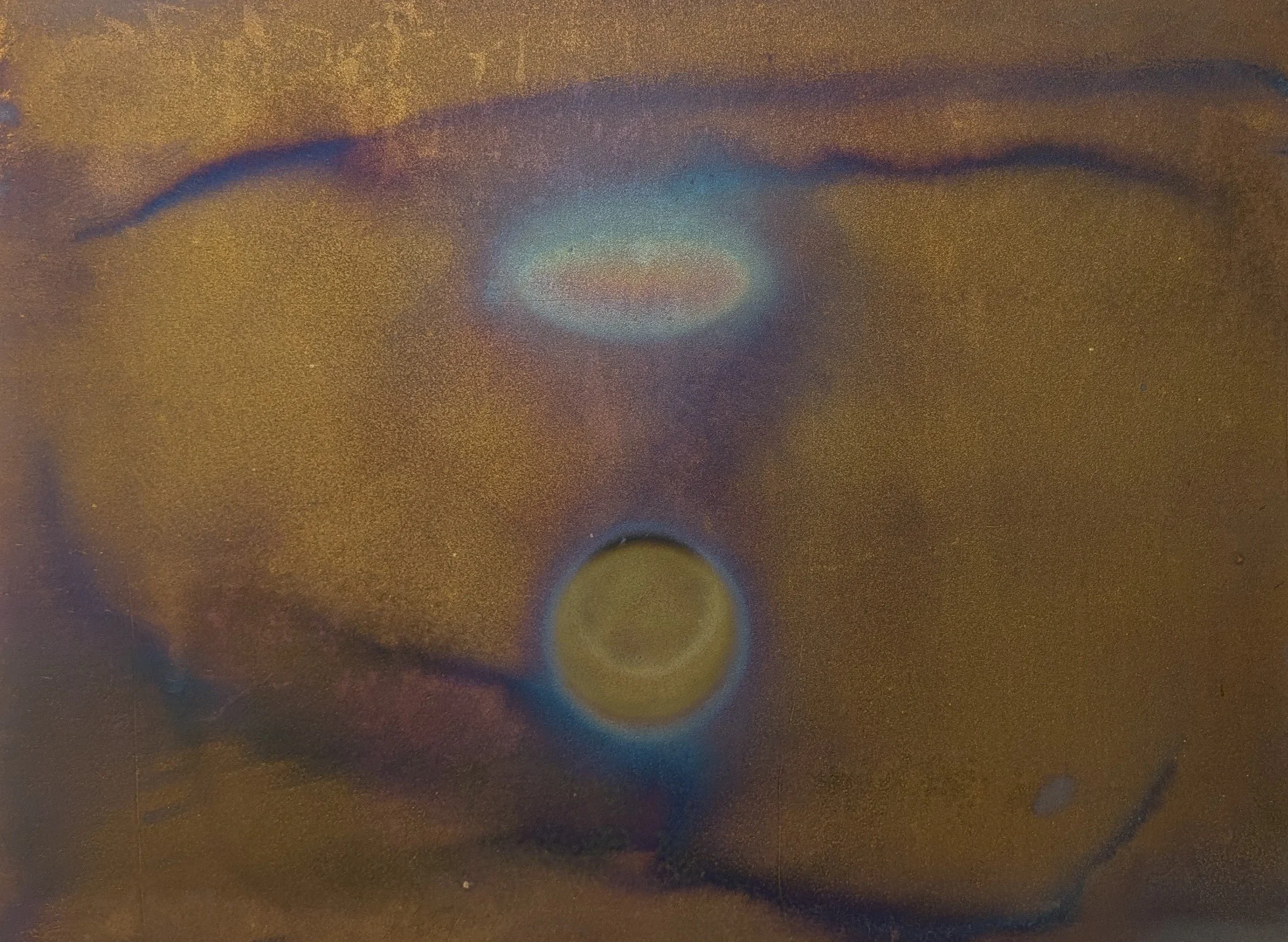
Matthew is based in Seattle, where the forests are his place for spiritual grounding. He builds community around hiking, arts and culture. Art and engineering have always been inseparable acts of creation for him. He invented the electric patina medium so that patina making would feel more like the live fluidity of blown glass he already knew. Technical foundations for the artwork came from developing pulsed power instruments that enabled a decade of cancer research, and from his PhD research on the neural interface for the first FDA-approved retinal implant to restore sight to the blind. Matthew currently works in AGI research, at the intersection of computer science and consciousness.
Matthew’s metal patina works are views into the greater multi-dimensional reality that knows neither time nor space. He creates art in tangible conversation with natural forces outside the range of perception. These works are places where the hidden has come into range and stayed, imprinted into the metal itself rather than painted onto it. Each begins with a form visualized in meditation and recorded as an ideogram; from that he builds counter electrodes that structure electric fields into the intended form. A field has no surface, occupies no volume, and is present everywhere at once, yet it acts on matter, and the metal records the field while reshaping it. His patinas come out of a playful dance at the edge of the material world. Each piece is the presence of the unseen, co-created with it.
Adelaide Blair |@adelaide_blair
Adelaide Blair is a conceptual artist and writer whose research-centered practice allows her to interact with and learn about the world. Her work involves publishing, printmaking, needlework, drawing, writing, performance, and filmmaking. She is also interested in distributed intelligence and how people make art together, and many of her projects involve elements of collaboration or participation. Her current project is a simulation, The Pacific Northwest Conceptual Art Center (a conceptual art project). Originally from Southern Oregon, Adelaide currently resides in Seattle, Washington. She has a BFA from Southern Oregon University, an MBA from the University of Washington Foster School of Business, and an MFA from the Pacific Northwest College of Art.
This booklet details the occult properties and uses of the rare-earth element Yttrium. I have been thinking a lot about the possible intersections between natural magic, science, and conceptual art, and this is my first attempt at putting something down on paper. To determine my subject matter, I drew a card from Suzanne Traister's oracle deck "Hexen 5.0." This deck, while configured like a standard tarot deck, contains images related to science and technology in order to allow groups to "discuss and envision positive alternative futures." I drew the Ace of Pentacles, which contains an image detailing the rare-earth elements. I did some research and decided to stick to one element, Yttrium. I then proceeded to draw a card from the Rider/Waite/Smith tarot deck specific to Yttrium to guide me in the exploration of how it could be used for magical purposes.
Christen Coomer | @deo.jewelry.design
Christen Coomer is a studio jeweler and metalsmith in Seattle, working at Side Rail Collective in Georgetown. Her practice takes its name from her grandmother Deodata, whose enameled boxes, painted rocks, and Egyptian Revival jewelry taught her that objects carry the people attached to them. She works in the reliquary, locket, and memento mori traditions, building wearable containers that ask whether a made thing can serve as a prosthetic for memory rather than a symbol of it. Found objects, unconventional materials, and material provenance recur throughout. Recent work includes the series "We Had Nothing In Common," shown in the collective's members exhibition, and a body of work made through the Reliquary Engine, a twelve-week studio program she designed around that question. She is president of the Seattle Metals Guild, and kept a bench through decades as a designer in tech.
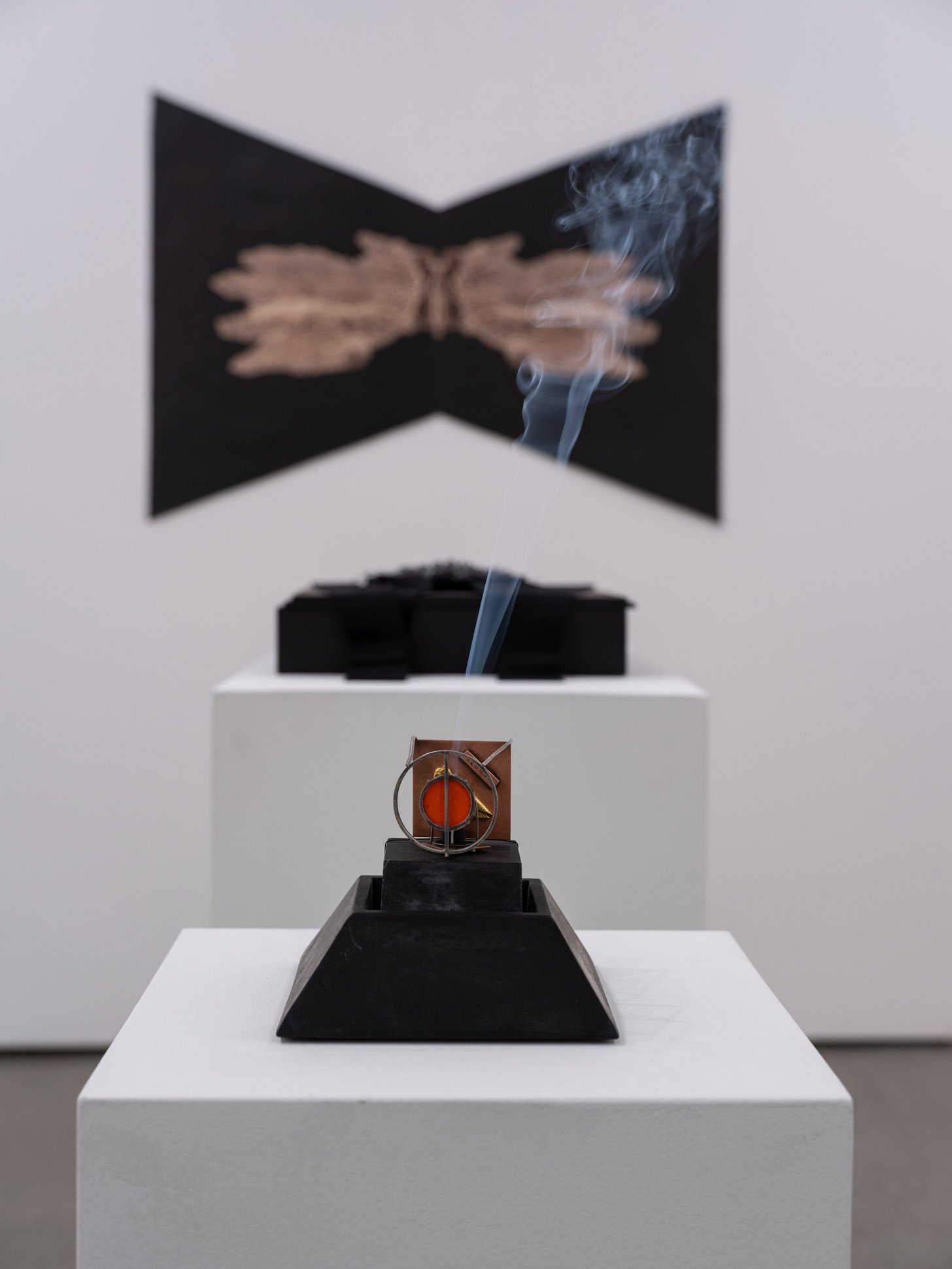
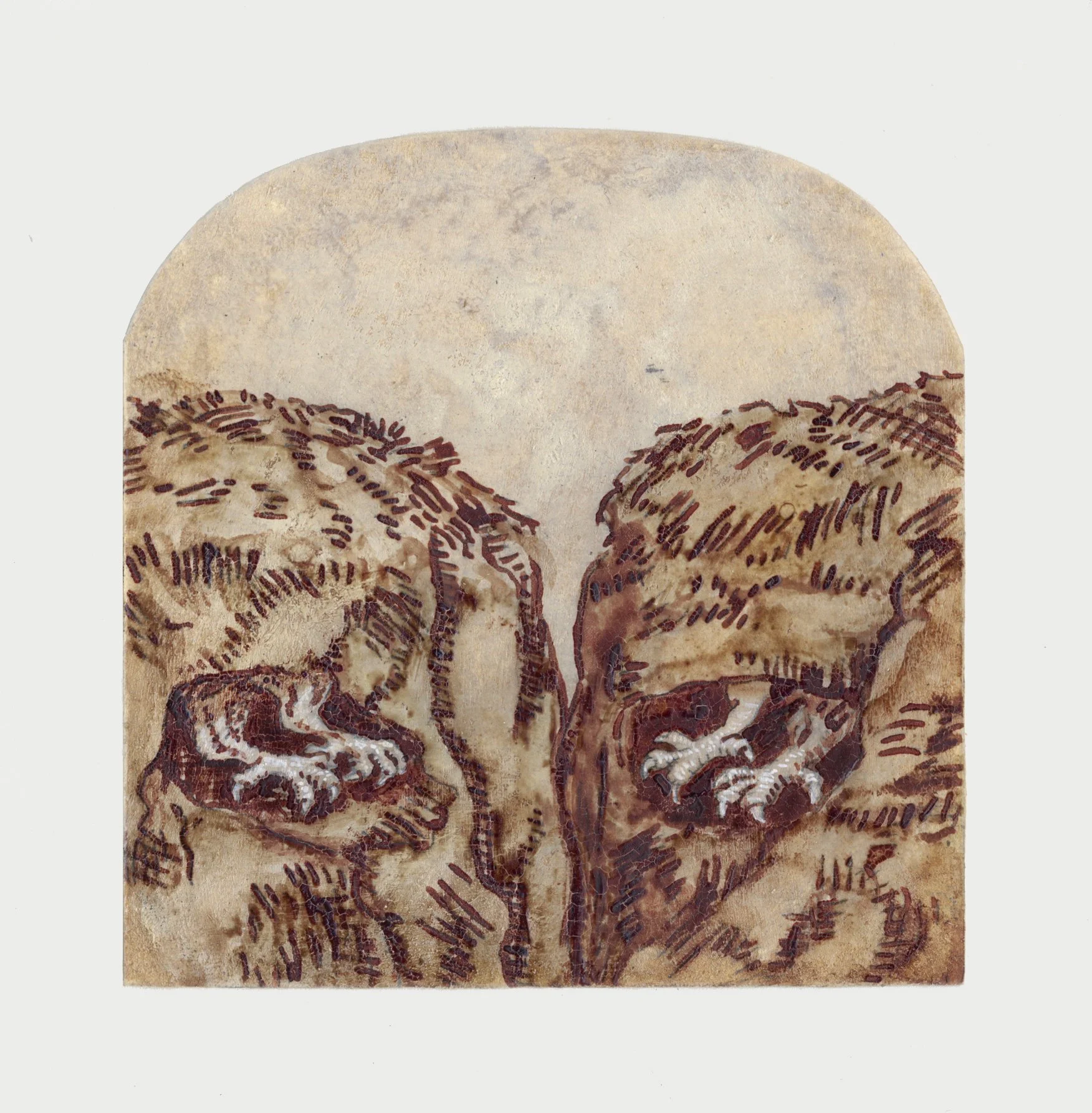
Scrying is divination by smoke or mirror — you look until meaning surfaces. "Scrying My Eyes Out" is a companion to a companion: an opening at its back holds my grandmother Deo's Egyptian Revival owl pin, so the owl is worn even as it wears my piece. He faces a mirror in dimensional sterling wire, BEHOŁD stamped on copper behind him — every letter struck upside down so the mirror rights it, except the L, which betrays in reflection. Below, incense burns in a cathedral-arched cage, smoke rising between owl and glass. Concentric bisected circles borrow Hilma af Klint's geometry of divided and reconciled opposites, and her conviction that a made thing can receive rather than depict. I build reliquaries that work to function rather than symbolize. The owl has waited longer than I have. We light it, and ask for what we have no other way to reach.
Carolyn Drake | @carolynhazeldrake
Carolyn Hazel Drake is an artist and arts educator based in Phoenix, Arizona and Portland, Oregon. Working across textiles, ceramics, and installation, her practice is centered in craft traditions and intergenerational knowledge shaped by early years spent with four generations of women at her mother’s quilt store. Her work engages sacred and domestic forms, ornament, and architecture as structures that shape attention and stage visual, tactile, and spatial encounters. Drake studied English Literature and Architecture at Portland State University and holds a Master’s in Art Education. She has two decades of experience in public, museum, and community arts education, including work with the Smithsonian American Art Museum and Portland Art Museum. She has taught workshops throughout the Pacific Northwest and received residencies and grants from GLEAN, Sitka Center for Art & Ecology, Arcosanti, the Icelandic Textile Center, and Center for Craft. She joined Arizona State University’s art education faculty in 2022.
This small tapestry takes the form of a double-barred cross, woven from botanically dyed wool, linen, and horsehair. The cross functions as a devotional form, an archetypal shape hat has carried many meanings across cultures and centuries. My interest lies in its capacity to hold the energy of its materials alongside the accumulated gestures of making. Translucent hatching allows color, structure, and light to interact, while horsehair extends beyond the edges to cast shifting shadows. The ritual of weaving is central to the piece: hundreds of repeated gestures gradually transform simple materials into an object that is both mundane and enchanted. The work considers weaving as a practice where sustained attention to material becomes a means of observance. In its original sense, the occult names that which is hidden or concealed; here, making becomes a way of approaching the unseen.
Shane Fosse is an interdisciplinary artist working across poetry, sound, and performance. As a native Texan influenced by the Southern Gothic, their projects exist as sustained exercises in memory and emotional honesty that discuss spirituality, belonging, and resistance. Their work has received support from many organizations, including the Illinois Arts Council and Luminarts Cultural Foundation.
It was Dutty Boukman and Cécile Fatiman’s rites that ignited the Haitian Revolution at a Vodou ceremony in August of 1791. Exactly forty years later, Nat Turner led his own rebellion in Virginia after witnessing an eclipse and receiving a series of divine visions thereafter. Despite these accounts, spirituality is often overlooked as a liberatory tool. Afro-Diasporic religions, such as Hoodoo and Santería, have long been demonized as witchcraft — sending them underground to be practiced in secret. Now many descendants steer clear for fear of engaging in evil or dark magic, leaving one to wonder if we have left ourselves vulnerable by abandoning these practices. As christofascism regains strength and popularity, perhaps it is time to return to the old methods of defense. Through performance, an american hex will invoke these histories as a spiritual act of resistance to be strengthened by the audience’s presence and participation—like all protests.
Taylor Hanigosky | @taylor_hanigosky
Taylor Hanigosky (b.1993) is an interdisciplinary artist tangling fiber arts and performance within the thicket edge-lands of the blue ridge mountains of Virginia where she studies the relationships between craft and landscapes. Her material interests include spinning wild fibers, weaving with handmade looms, and felting large blankets through dance. Collaboration and participation are important parts of her creative practice that centers the exchange of skills, resources, and experiments in community-scale fiber crafts. Taylor has taught feltmaking, spinning, and weaving through many formal and informal institutions and groups including the Visual Arts Center of Richmond, The School of the Alternative, the Valley Career and Technical Center, as a visiting artist at James Madison University, and through the private studios at Appalachian Piecework and Wild Altar Farmstead.
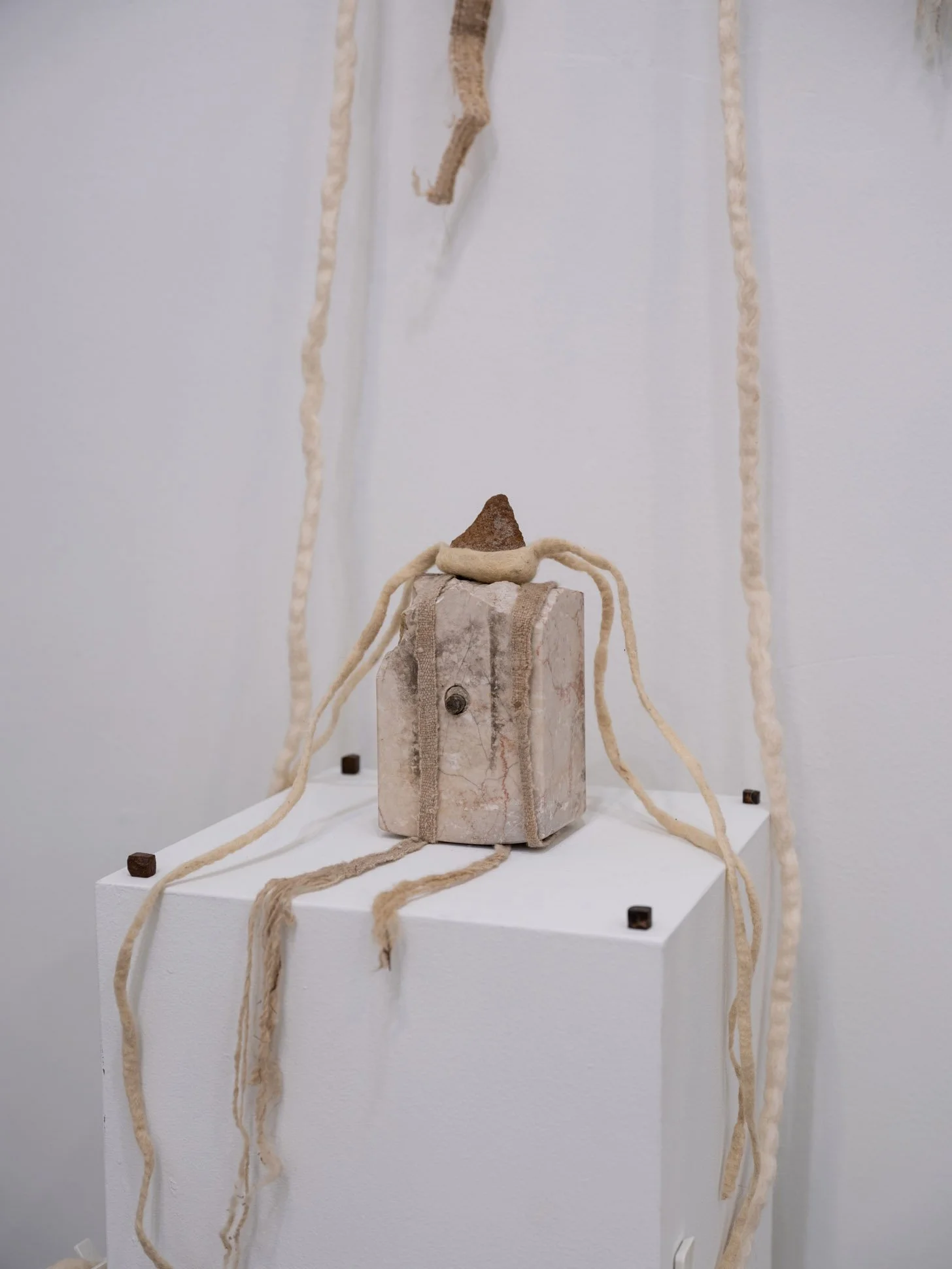
I am leaning into a fiber-based materials study that instructs the body into postures, articulations, gestures, and even dances which can interrupt linear time scales to share knowledge and information. My current work fabricates, weaves, felts and fastens all manner of tethers, straps, belts, bands, and vestments intent on following the recurring attachments between time, body, memory, and place. Often these straps are woven from my personal and specific experiences of speaking with particular beings and dwellings and are a form of understanding my own attachments through ritual. In some instances, the work is collaborative, and follows the inquiry of a group of participants in guided performances. Both approaches are rooted deeply in the embodied process of fiber craft to communicate nonverbally through emergent ritual.
Vee Hua 華婷婷 (they/them) is a writer, filmmaker, and artist. Their work unifies their metaphysical interests with their belief that art can positively transform the self and society. They are the Editor-in-Chief of REDEFINE magazine and are in post-production on their first feature film, RECKLESS SPIRITS, which is a "metaphysical, multilingual POC best friend comedy for a bleak era." They were recently Interim Editor-in-Chief at International Examiner and Interim Managing Editor at the South Seattle Emerald. In over four years as the Executive Director of the interdisciplinary community hub, Northwest Film Forum, they played a groundbreaking role in making the space more welcoming and accessible for diverse audiences. In 2025, they premiered their documentary short, HUNT'S TRADING POST, about a Navajo-owned third space. In 2022, they released their short proof-of-concept for RECKLESS SPIRITS, and in 2017, their narrative short, SEARCHING SKIES, about Syrian refugee resettlement in the United States.
Chinese has a "morphsyllabic" writing system. Each word is depicted by an symbol or character—essentially, a picture. Oracle bone script 甲骨文, the earliest written Chinese language, dates back to the Shang Dynasty (1600-1050 BCE). Character forms were engraved onto ox bones and tortoise shells, then used for divination and as spirit conduits. Oracle bone script is simultaneously illegible and legible. Due to systemization of the language, many modern Chinese readers cannot read it, yet due to how pictographically representative it is of its original subjects, it can be legible. In oracle bone script, the word for horse looks like a horse, whereas today, it looks like 馬. "From Oracle Bone Script to Modern Day Divination" is a series that combines my divination practices and investigations to create mixed media embroidered works that invite viewers into the world of written Chinese.
Nell Kerr (he/him) is a multidisciplinary artist born, raised, living, and working in Seattle, WA. A self taught artist with a BA in body modifications as therapy from Fairhaven Interdisciplinary College, he works primarily in figurative and surrealistic acrylic paint and illustrative print zines, also incorporating watercolor painting, mixed media, and collage elements into his work. His most notable body of work is an ongoing series of nude self portraits creating a pantheon of fantastical altar egos, including a series of tarot card designs. In the past year his work has been featured at local galleries including Slip, Side Rail Collective, Base Camp Studios, Phase 55, Push/Pull, and more.
I find art and divinity to be greatly interconnected, with art serving as portals into magic worlds. The very process of creating is divine, drawing from the universe and translating the unwritable. In that same vein of art magic, I find myself perpetually returning to the visual language of mythic symbology and fairytale motifs that first inspired me as a child. With these pieces, working in collage and mixed media is a way of letting the texture of the past shape the present, a kind of rebirth in itself.
S. Lantz is an artist and researcher currently working in ceramics. Their practice, launching from personal experience, focuses on art and cultural production in the Vietnamese diaspora, material histories of porcelain, and queer life and history in the United States. They are attentive to the ways that diasporic memories refract through objects. Lantz has exhibited ceramic work across the United States and in Taiwan, Japan, China, and Italy, and have participated in residencies including Watershed Center for the Ceramic Arts, ACRE, Penland School of Craft, Anderson Ranch Arts Center, and Tainan National University of the Arts. Raised in Washington state, Lantz received their Bachelor of Arts at the University of Washington, Seattle and their Master’s of Fine Arts in Ceramics at the University of Arkansas. They live and work between Chicago and Vermont.
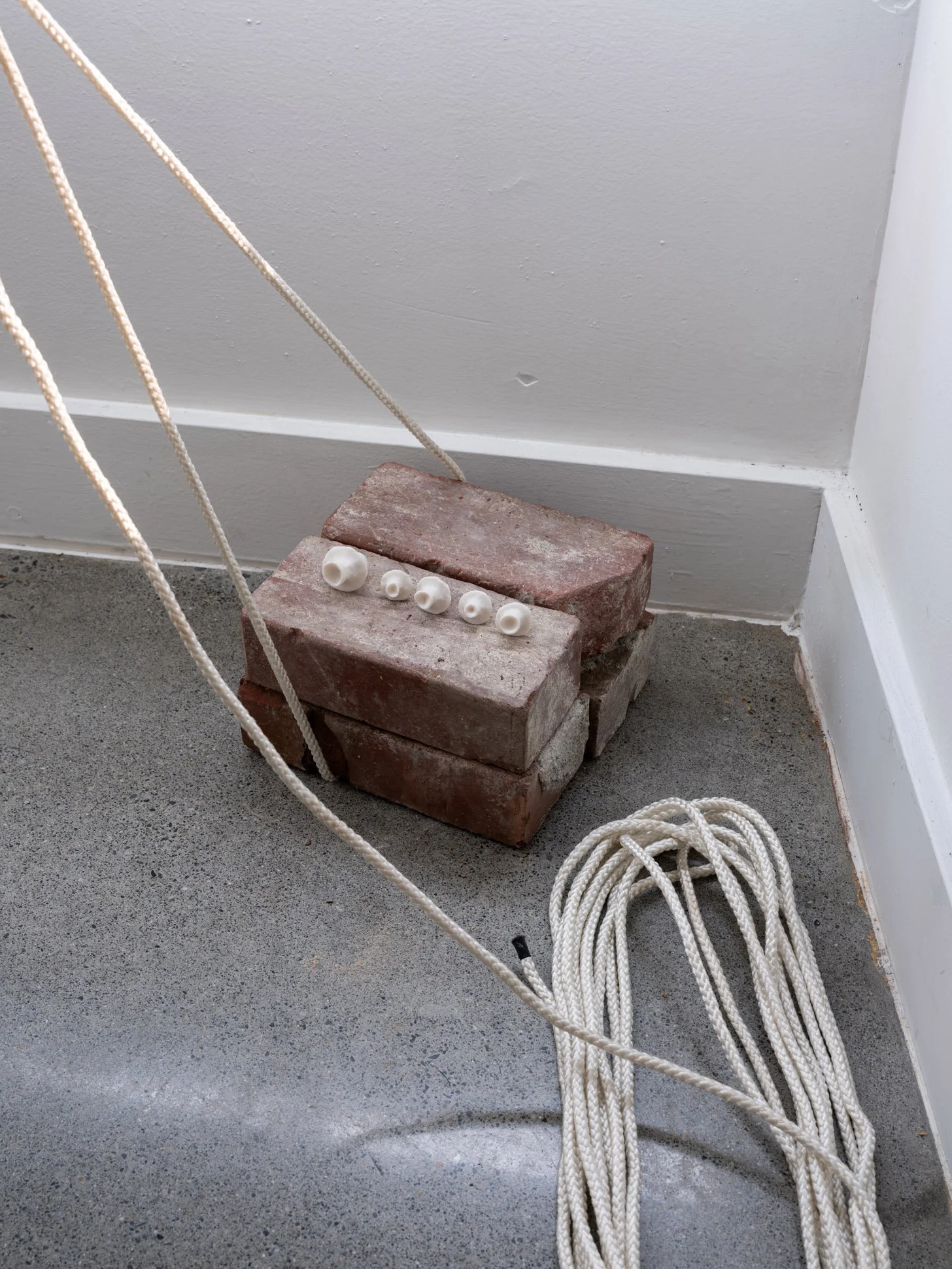
The sail is a to-specification mainsail for Just Enuf, the boat my father learned to sail on. The horizontal fabric strips composing the sail directly reference the color and dimension of Vietnamese funerary garments. Engaging with familial funerary traditions becomes my conduit for understanding and honoring worlds beyond ours, including ones where the deceased may journey to. The battens (sail supports) and grommets handsewn into the sail are sculpted from porcelain clay. Ceramics is inherently attuned to the occult – it is defined by material transformation, phase change, and intentional, repeated processes.
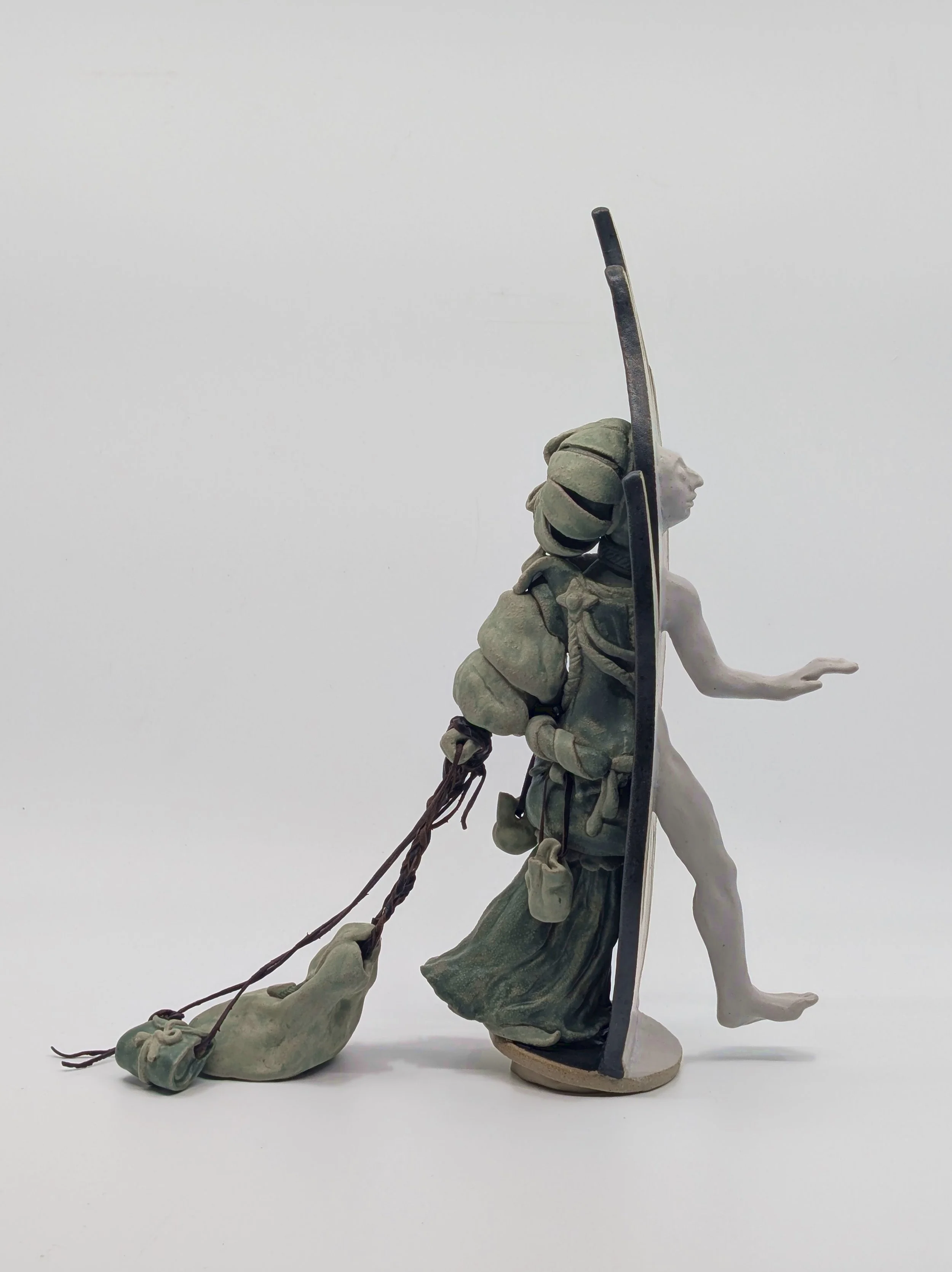
Kester Limner is a Seattle-based sculptor and illustrator whose work explores the construction, mutation, adornment and entrapment of the symbolic body. Drawing from the disciplines of cartooning and religous iconography, Kester's emotionally resonant ceramic characters invite the viewer to participate in liminal states of being.
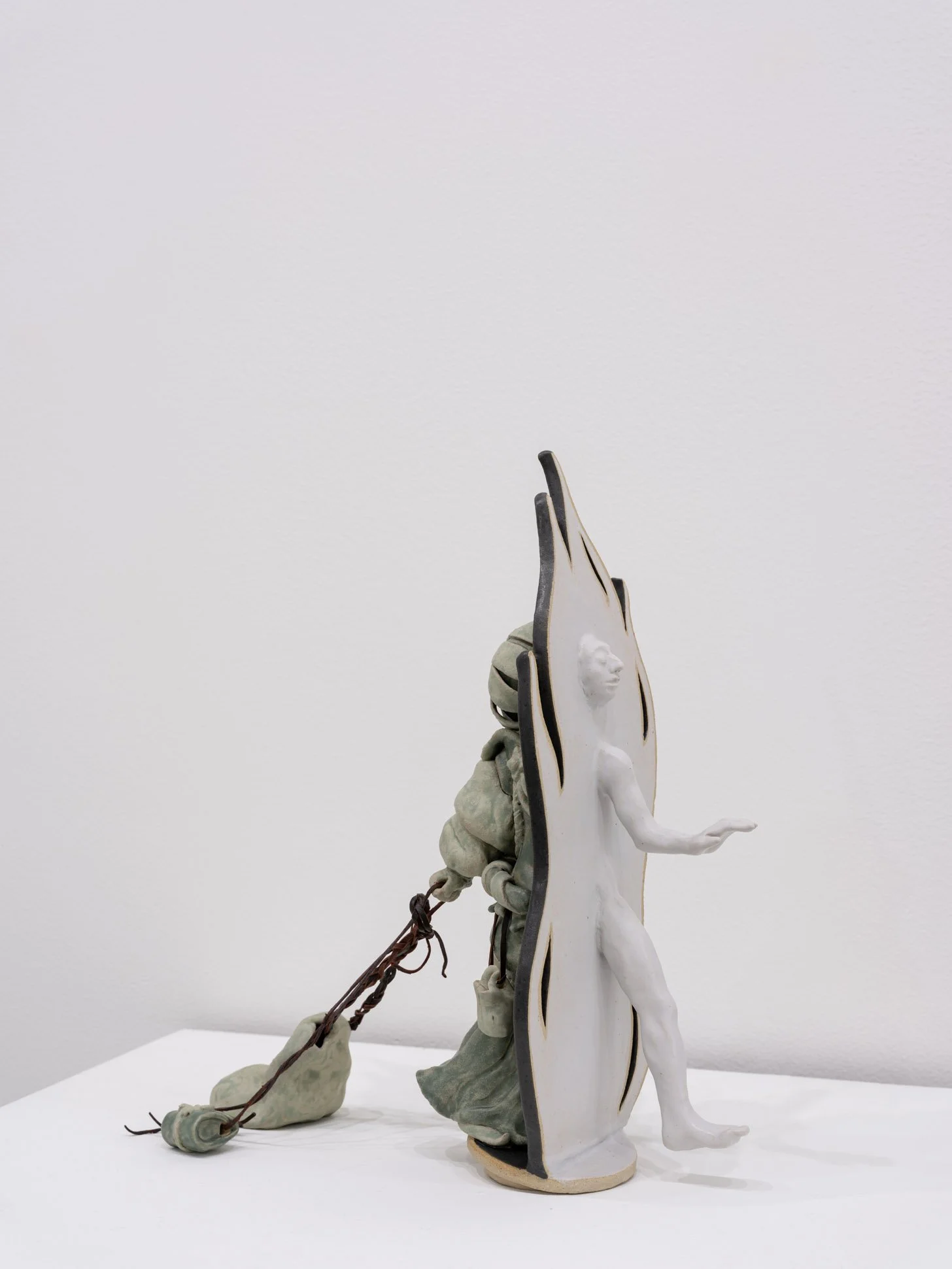
Passage may refer to death, apotheosis, enlightenment, or alchemical transmutation. In any of these cases, destruction and transfiguration are the same process. Although some may seek it willingly, it is right to fear the Passage. We hoard layers of protection, but all that defines us must be burned away. The firing of stoneware is an act of transfiguration itself, and the form of the doll allows us to comprehend a small model of our physical and spiritual self. This piece questions what is changed in the moment of Passage, what remains, and how we can describe what cannot be understood.
Quinn Mcnichol | @quinnmcnichol
quinn mcnichol grew up in Glenside, Pennsylvania. During high school they studied independently with Philadelphia artist Marcia Jones. After earning their BFA, quinn spent a summer visiting Romanian artist Alice Schwager at her home studio in the woods of Lancaster County PA to explore spiritual art therapies and expand their emotional perception of their creative practice. Several summers spent at Mount Gretna School of Art (MGSoA) have been incredibly impactful to quinn’s creative career and studio practice. In 2019 quinn moved to the Pacific Northwest to continue their formal studies in Painting & Drawing at University of Washington in Seattle WA. quinn now spends their summers in Seattle, tending their medicinal herb garden, and winters in Wonder Valley, CA, where (amongst many creative endeavors) they make music with their band Skunk Cabbage.
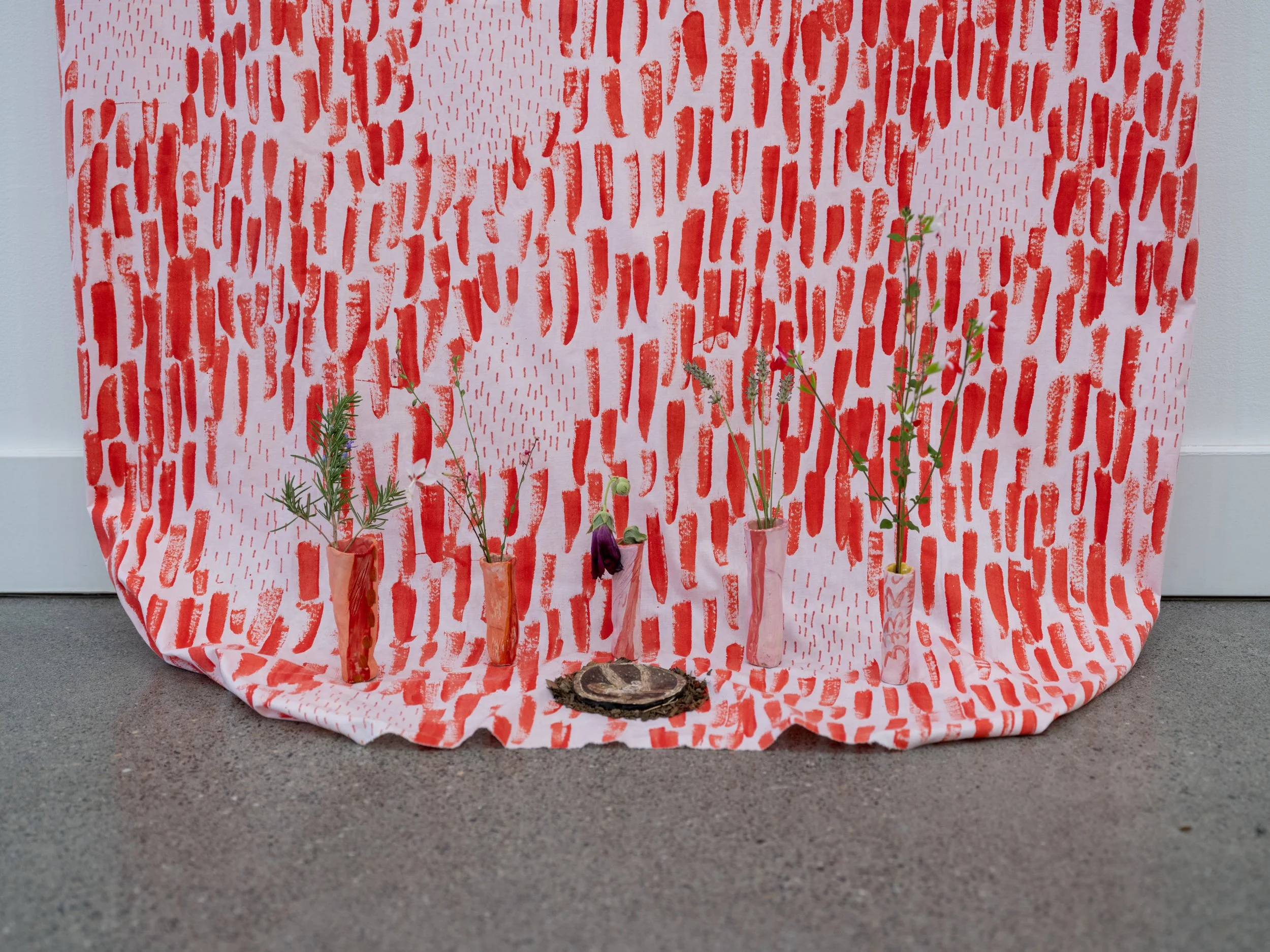
The summer of 2024 I found a dead dried carnation on the studio floor at Mount Gretna School of Art in Pennsylvania. I wondered who it had belonged to previously, and what kind of love it represented for them. I tucked it away to reflect on later, when I returned to Seattle. While unpacking my things, I stumbled on my own memories of blooms past: images of beloved deceased family members, relics that were once looked at or used daily, and dreams typed on paper and painted over as the ideas evaporated. These collected items were kept in a box, hidden from view, only to be pulled out in moments of quiet reflection. By arranging them together in a transparent bag - the same kind I use for keeping dried herbs collected from my garden - I attempt to preserve the memories in the same way medicine is preserved in dead dried flowers.
Brenda Palma is an emerging Mexican-American artist based in Washington, working in digital collage and video art. She creates layered visual narratives from photographs and archival materials, exploring how memory, cultural inheritance, and identity are shaped and distorted. Palma studied art at the University of Washington and has exhibited in group shows at Neplantla Cultural Arts Gallery. Her practice is driven by a desire to understand her place within family and culture, engaging in an ongoing process of questioning inherited roles and expectations. Returning from a two year hiatus, her current work is a reflection of belief systems in healing and inherited histories.
The triptych consists of digital collages depicting the tool, act, and reading of a limpia. The creation of this piece is the result of a personal reflection on belief systems in healing, family relationships, and inherited histories. Its connection to the occult emerges from its ritualistic structure and its inclusion of otherworldly figures and ancestral knowledge. Rather than documenting the ritual in an ethnographic manner, my interest lies more in exploring my own understanding of the ritual. The symbolism, emotional weight, and the way it shapes my relationship to culture and family. This project emerges from previous research on curanderismo and religion.
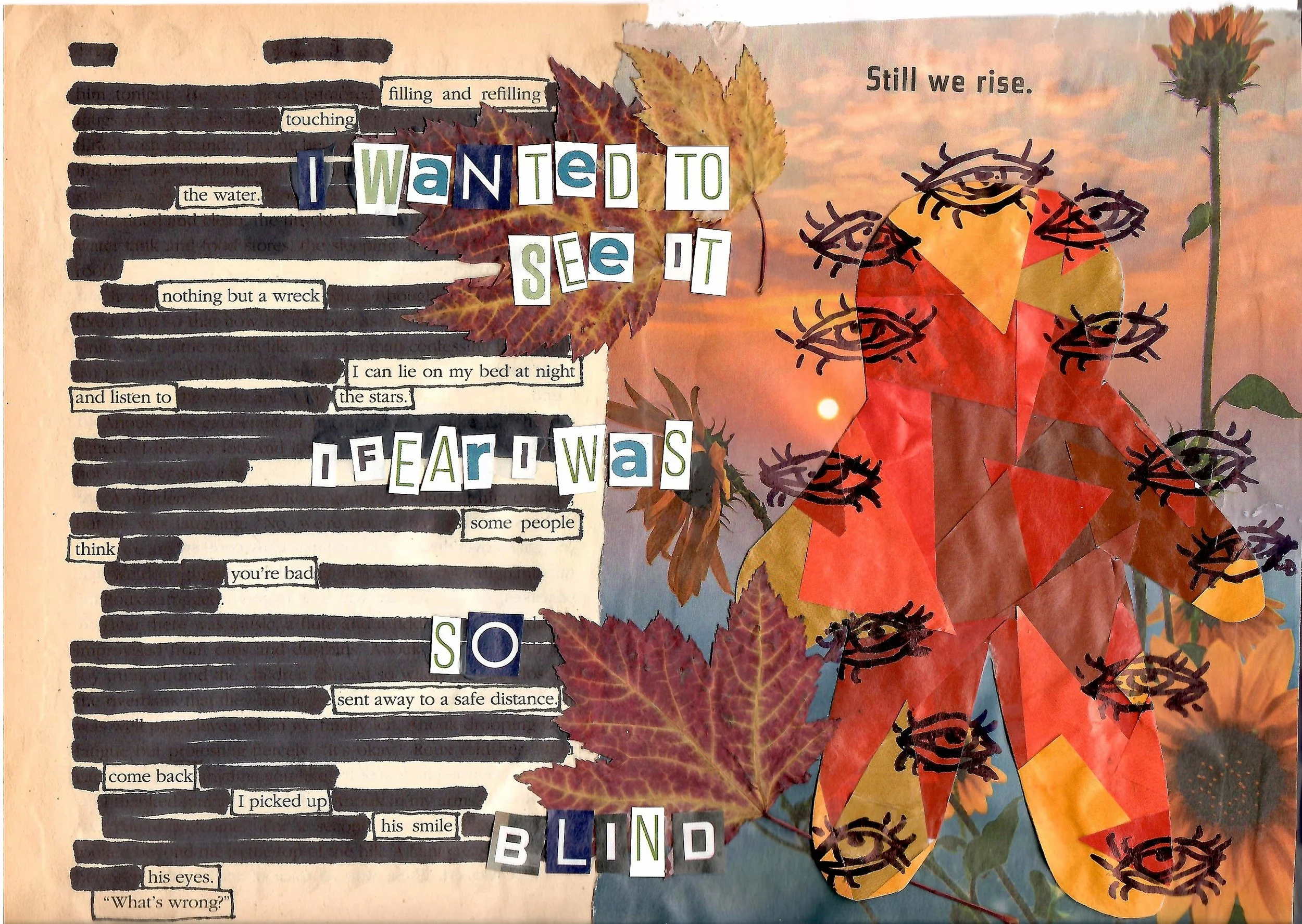
Growing up in the ever-changing visual landscape of the Pacific Northwest with a keen eye, a passion for narrative, a gravitation towards the darker and more subterranean aspects of the human psyche, and a fascination with paper and found objects, I was introduced to Surrealist art and Surrealist collage in the mid ‘80s and continue to find this medium a significant channel for artistic expression. I began exhibiting and selling my work in the early ‘90s, creating increasingly evolving bodies of work that began with figurative narratives, progressed to visually integrated dreamscapes with intertwined figures and backgrounds, and developed to include site specific works, book art, and mail art in a variety of forms and themes.
In this piece, a number of cosmic forces combine to create a singular vision. The creation of this work was itself an occult practice, starting from the disparate pieces that mysteriously made their way into my image collection and then aligned to reveal a secret or hidden message, which is not directly translatable, but rather felt or experienced on a deeply personal level. My art practice works directly with the subconscious, to channel inchoate meanings that could be said to most closely align with a kind of darkly spiritual realm.
Devin River (b. 1985, Eugene, OR) is a textile artist living and working in Olympia, WA. They received their BA in sociology and minor in poetry from the University of Oregon in 2017. As a musician, River released three experimental albums under the moniker Entrail. River is self-taught as a visual artist, employing their experience with poetry and music in their textile works. With careful patterning, intuitive sewing, and reclaimed materials, River explores our indelible value as creatures of an increasingly unstable world. River was awarded a Space Grant from Olympia Artspace Alliance in 2025, and has exhibited in Olympia at Childhood’s End Gallery, The Washington Center for the Performing Arts, TCMoFA, and Bar Francis; in Seattle at Slip Gallery and the Artist Trust Benefit Art Auction; and in La Conner, WA, at the MoNA Art Auction. River was selected as cover artist for Olympia Fall Arts Walk in 2026.
Working with scavenged materials is a ritual that grounds me in the physical world beyond my head, allowing me to release my internal pressure valve of existential overwhelm. That pressure releases slowly, the way working with fiber is slow, and I am able to transform my abstract thoughts into abstract visuals. I honor the strange and glorious chaos that pushes outward from the mind when it finds an opening. I Cast Unambiguous is a spell to sculpt that chaos into insight. I want to sort and stitch together the pile of fragmented thoughts so that they become tangible, building cell by cell, blooming like a mushroom.
Chris Russell | @potsandpixels
Chris Russell is a ceramicist based in Seattle. He came to the arts by an unusual route — as an engineering undergrad teaching a robotic arm to paint — and landed in ceramics in 2016 after detours through painting, photography, and metalwork. He has since worked as a studio potter in Seattle-area community studios, where his ceramics training has come entirely from classes and studio time. Chris works primarily on the wheel in cone 6 stoneware, making functional objects—cups, jars, teapots, etc—and ultimately seeks to celebrate the everyday. He is less interested in putting visuals on a piece than in the visuals of the piece itself. Throwlines, groggy clay, facets, and coil appliqué are the bones of the work, finished with glazes that break over sharp edges and pool in recessed textures. His recent work focuses on adding coil and slab applique to thrown pieces, adding sculptural elements to functional wares.
The Divine is infinitely vast and unknowable, making it impossible to truly understand. I like the idea of understanding it through smaller avatars that offer a more intimate glimpse, so I constructed a pantheon of deities with oddly specific portfolios. Gods OF small things that ARE small things. I’ve aimed to make them look otherworldly and ancient, yet not off-putting. I wanted to make them look like something that’s been sat for eons right where it was when when life crawled out of the ocean, but would be happy for you to sit and chat a while.
John Schmitz creates and documents offerings, altars, and arrangements of found materials that time and tide soon reclaim. His practice is rooted in the islands of Skagit Bay and reflects the cycles, reciprocal relationships, and robust fragility of that locale.
Migueltzinta Solís & Nayan Velaskar | @cauhboi, @n.velaskar
Migueltzinta C. Solís is a trans Chicanx interdisciplinary artist, writer, scholar, filmmaker, educator, land tender, and Tarot practitioner. He was raised in California and Mexico by parents involved in the Chicano/a Movement from the 60s to the 90s. He works at a unique intersection of art, land-relation practices, radical pedagogies, Indigenous futurities, and divination. He has worked in performance, video, photography, leather, textile, installation, and site-based works. Migueltzinta holds an MFA in Art and a PhD in Cultural, Social and Political Thought from the University of Lethbridge/Iniskim in Treaty 7, traditional Blackfoot territory. He has learned his cultural practices from his parents and others. He stays in Oregon.
Nayan Velaskar is a queer, brown new media researcher from Mumbai, India. He is pursuing his doctoral studies in the Department of Design and Computational Arts at Concordia University (Tiohtià:ke, Montréal, Canada). His ongoing research focuses on critical Anthropocene studies, the archival use of gamic media, and Indigenous language rematriation. He has worked as an instructor and mentor at Iniskim (University of Lethbridge) situated on traditional Blackfoot territory.
Chicanx Grimoire is a constellation of ritual and practical creative works from border-defiant life lived close to the land. Limpia brings together Tezcatl (obsidian mirror) scrying practice with limpia practice to heal disturbance brought on by ICE, data centers, and corporate/state surveillance. Limpia blends photo and video documentation of site-specific acts, archival research, spellcraft, and ritual object creation presented as a short video. Tezcatl acts as earth’s camera: a portal and a witness. Presented as part of a video-altar, Tezcatl combined with contemporary image capture bears witness to cycles of colonization and liberation. It opens portals through which water, land, and Native peoples might escape. Limpia and Tezcatl practices have endured many waves of colonization, inquisition, and political persecution, evidence they are powerful occult technologies which have helped our ancestors survive and can come to our aid now.
Jay Stoneking | @jaystonekingart
Jay Stoneking is a queer, Vietnamese-American artist and author. His works live in the boundary between art and the occult, drawing inspiration from fantasy and science fiction alongside symbols and forms from modern witchcraft. Stoneking's creative practice includes installation, traditional and digital mediums, game design, and written works. His graphic novel, The Unbound Arcana, is an ongoing fantasy series.
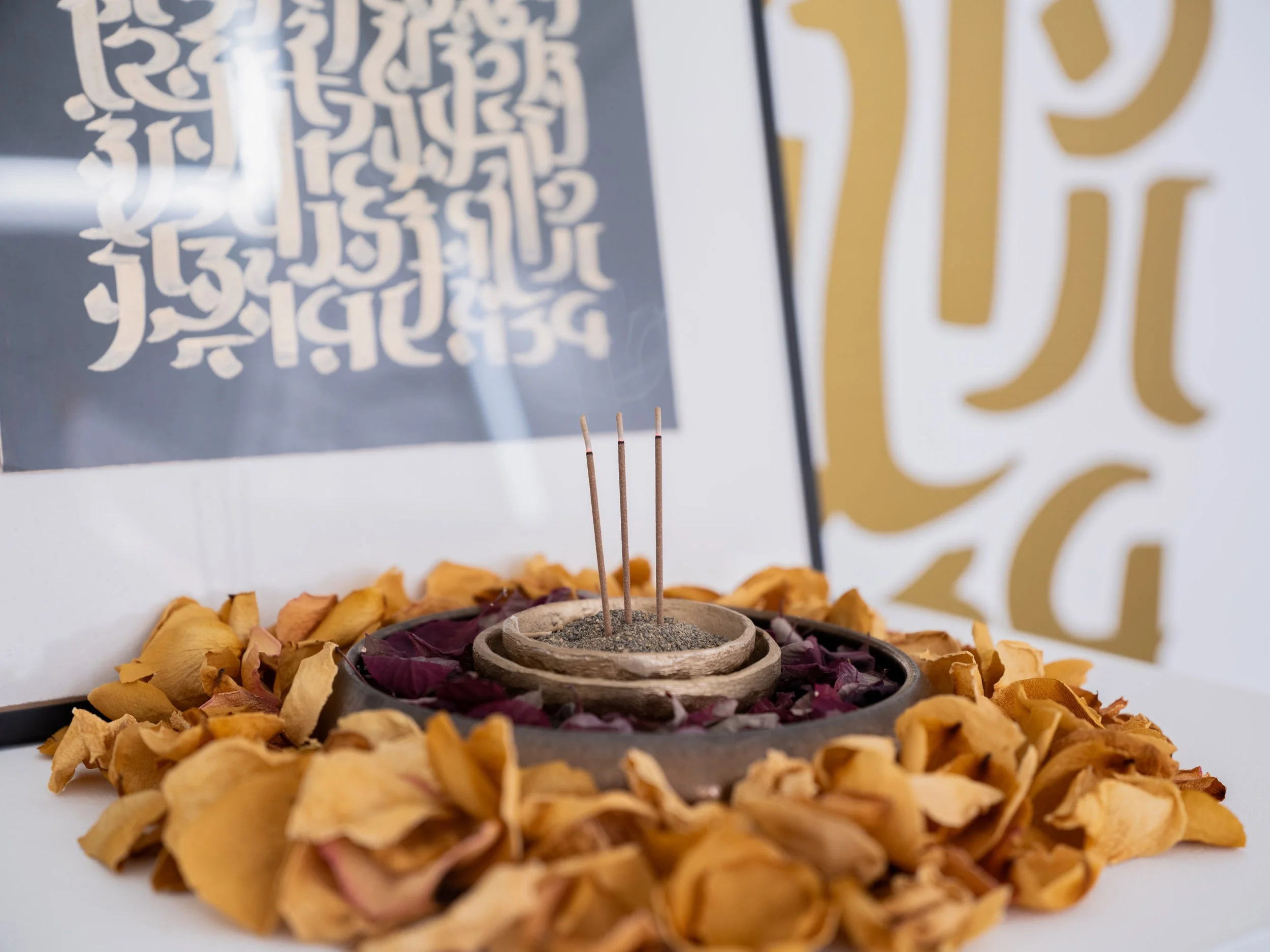
The gate guardian wards and protects. This altar uses an incantive as its focus, a sigil of protection specifically divined as a visual incantation to ward evil at doors, gates, and entrances. The sigil in the painting set at its center addresses those entering, while the sigil behind is transformed in size to magnify its power. I lay flowers at its feet in offering, and light incense each day to renew the spell's strength.
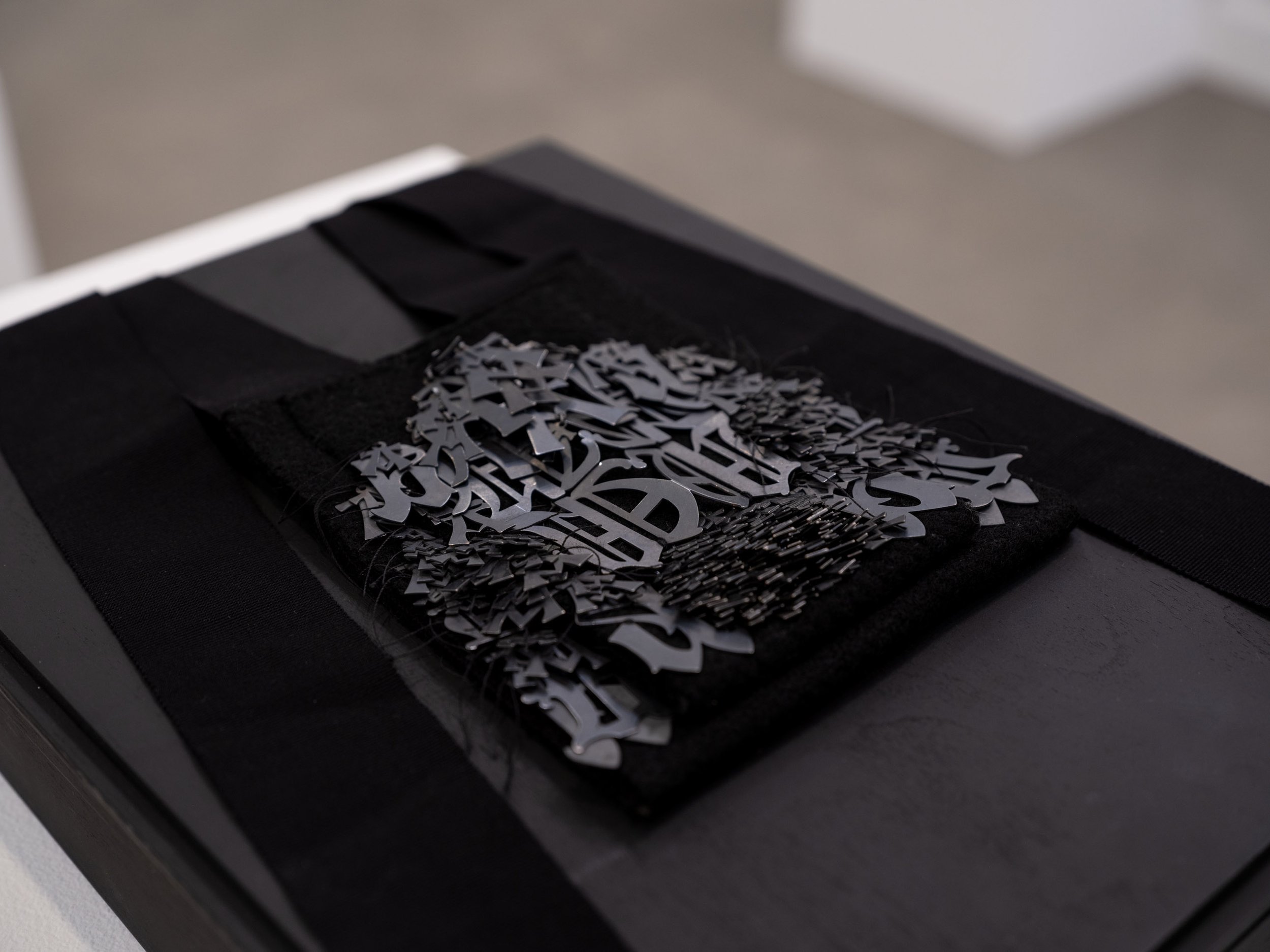
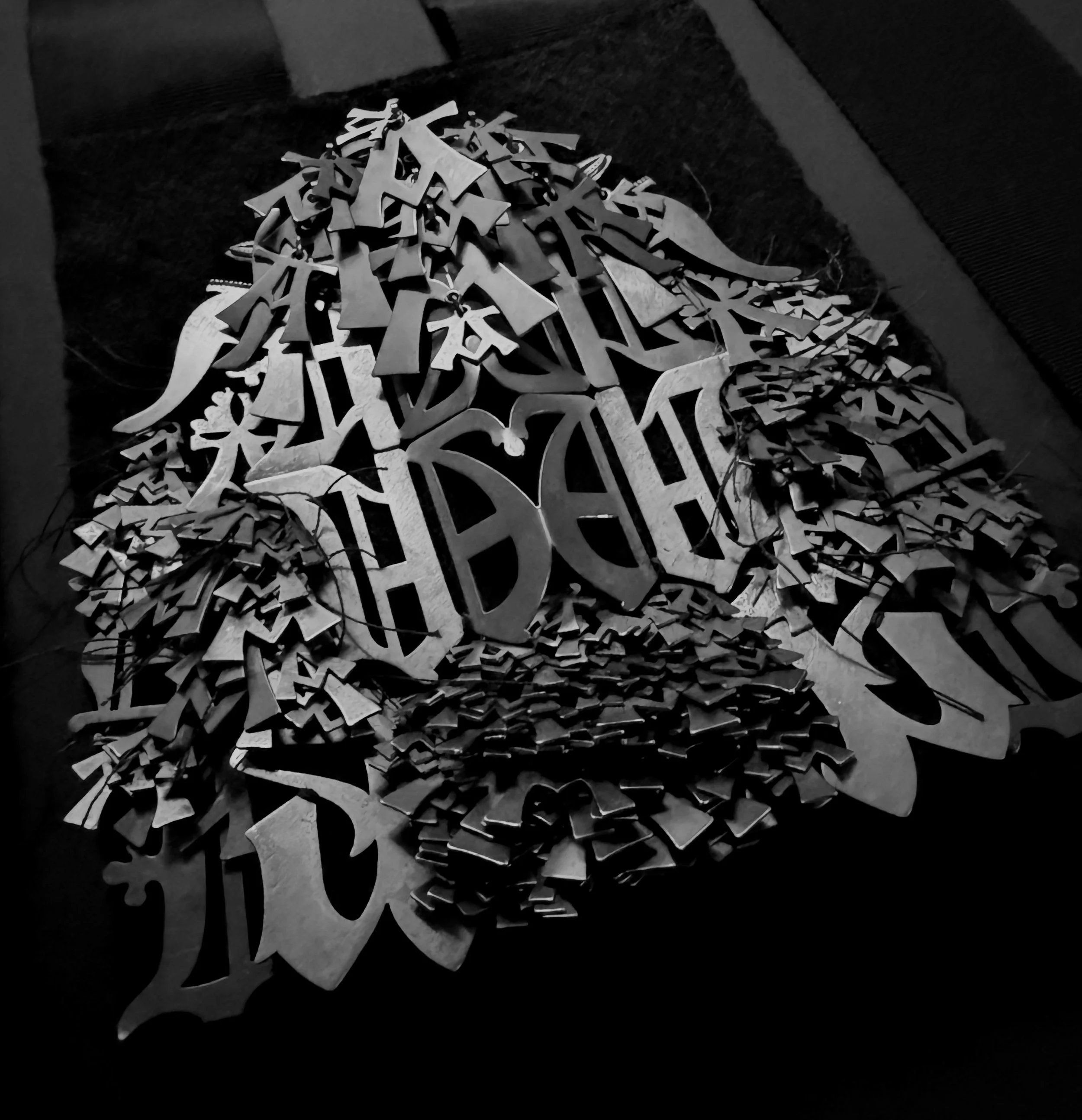
Lori Talcott is a craft-based artist whose work and research focus on jewelry as an agent in rituals that mediate social, temporal, and spiritual boundaries. Born into a family of jewelers and watchmakers, she trained with a master silversmith in Norway who specializes in traditional folk jewelry. After her undergraduate studies in art history and metal design, she earned her MFA. Talcott's work is held in collections worldwide, including the Renwick Gallery of the Smithsonian American Art Museum and the Museum of Arts and Design in NYC. She has received two Artist Trust Fellowships from Washington State and a Fellowship from the American-Scandinavian Foundation. In 2025, she was selected as a US-Norway Fulbright Foundation Scholar. A frequent visiting artist and critic in the U.S. and Europe, Talcott served for many years as a Guest Lecturer in the Jewelry + Metalsmithing Department at the Rhode Island School of Design.
Some stories endure longer than others. Myths of descent into the Underworld persist. The stories tell us that the usual rules don’t apply—there is etiquette to follow, and gates to pass through. These require offerings, and they don’t want our cellphones. The darkness may require old-world strategies: something ornamented, protective—as an offering, as a companion. Jewelry is such a companion. It knows what it’s about; it understands the task. During the pandemic, I made hundreds of silver “A’s”—as a spell, as a prayer; to mark time and bring something into being. Our medieval kin considered the Gothic letter “A” a powerful amulet, standing for Amor Vincit Omnia, love conquers all things, and Ave Maria, an invocation to the divine feminine. Words spoken materialize, becoming material incantations. Enchanted literally means to be within the song, the chant. A necklace allows us within the enclosure of the chant.
Meghan Thréinfhir | @meghanthreinfhir
Meghan Thréinfhir is a Seattle-based artist, writer, and curator working across sculpture, electronics, installation, performance, and code. Her practice explores relationships between computation and the natural world through bogs, electricity, cybernetics, cosmology, animism, and esoteric technologies. Drawing connections between ancient knowledge systems and contemporary computation, she considers technology as a material and cultural system through which humans attempt to understand and construct worlds. Her work has been exhibited nationally and internationally, including in Seattle, New York, Copenhagen, Berlin, and Barcelona. Recent solo exhibitions include Spacetime Gothic at Steve Gilbert Studio, Bog Memory/Computer Memory at Captive Portal in Copenhagen, and Let Us Not Confuse Zero With The Stillness Of Electrons at The Center on Contemporary Art (CoCA). Thréinfhir received her master’s degree from NYU’s Interactive Telecommunications Program and is Curator of the M. Rosetta Hunter Art Gallery at Seattle Central College.
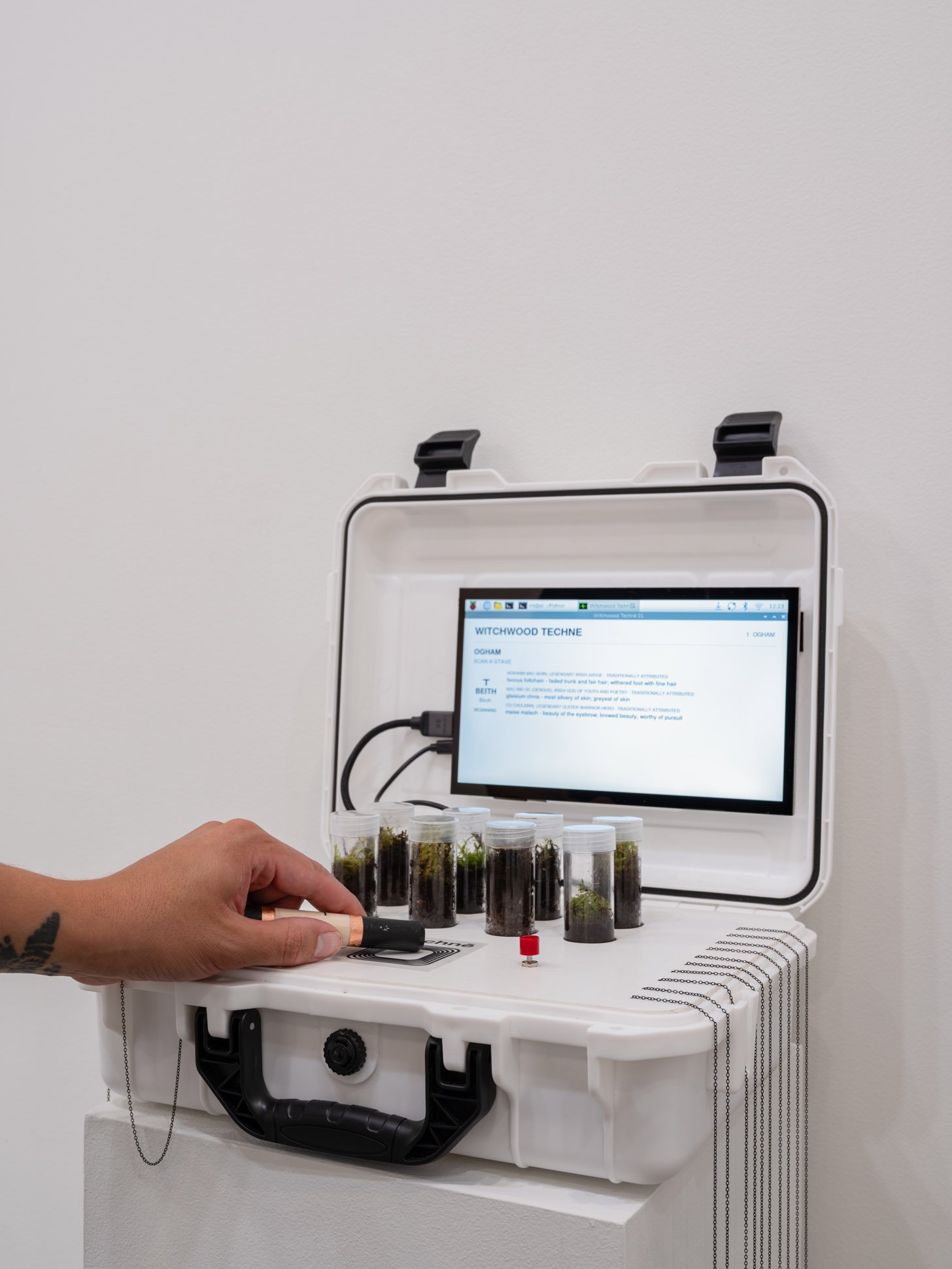
Witchwood Technē is an interactive sculptural instrument that reimagines computation through Ogham, an early medieval Irish writing system associated with trees, language, and later divinatory traditions. Ogham staves hang from the sides of a handmade cyberdeck and are manipulated by visitors; RFID and custom electronics translate their selections into a computational interface. The work approaches the occult as a technology of hidden relations: a way of reading signs, correspondences, and forces that resist direct observation. Divination and computation meet here as parallel practices of encoding, interpretation, and prediction. Drawing together wood, bog, code, and electronics, Witchwood Technē asks what technology might become if its lineage were imagined through relationships among language, landscape, and the more-than-human world. It proposes a speculative cosmotechnics in which computation becomes not simply an instrument of control, but a practice of sensing, interpretation, and listening.
Isla Vidal is a vocalist, composer, and interdisciplinary artist based in Seattle. Her practice centers the voice as a primary instrument, processed, layered, and live, across solo performance, generative music, and immersive sound installation, often building sonic rooms from live-sampled and found materials alongside custom instruments made from vocal samples and field recordings. Her EP Hija explores Cuban female ancestry and inherited memory through pop leaning songwriting and folk-rooted composition pushed into ambient and electronic territory. She is currently developing a new EP exploring electronic and ambient textures through a vocal lens. Recent performances include when we notice, a live generative set featuring looped vocals, improvised audience participation, and field recordings, performed at Ambient Crafts, Internet Development Studio, Seattle.
Unspoken Rites is a sonic room built live, in real time, that the audience is invited into like a scene already in motion. Vidal treats everyday gesture as incantation: the piece grows out of a single ordinary act, making a cup of chamomile tea, sampled and looped as it happens. Water poured, a held vocal tone, the kettle's click and rising whistle, tea poured and stirred, a spoon tapped against the rim. Each material keeps its own rhythm, layering into an unrepeatable polyrhythm rather than a fixed score. The work is interested in occult knowledge as something embodied rather than shown, hidden in plain sight within acts most people already perform, alone, in their own kitchens. By treating a private ritual as a public set, Vidal asks what it means to be let into someone else's self-soothing, and what changes in a gesture once it's witnessed.
Ellen Ziegler works in two and three dimensions and conventional and unconventional materials, in ways that reveal meaning through process. Mediums include mirrored glass, tar paper, rust, cyanotype, installation, chemically etched copper, birds’ nests, and drawing with an electrode on a copper table. She is also an award-winning maker of artist’s books in collections nationwide. Ziegler was featured in Anna Atkins Refracted: Contemporary Works in Cyanotype, New York Public Library; Vermilion at Desai Matta Gallery, San Francisco; It takes one to know one, at One and Other, curated by Antony Gormley and performed in Trafalgar Square, London; and Prognosticators, an installation at the Sofia Biennale, Sofia, Bulgaria. Recent residencies include the Centrum Artist Residency, Port Townsend WA and the Amazon Artist in Residence, Seattle. Awards include Artist Trust Fellowships in both Visual Arts and Design, a Foundation for Contemporary Art Travel Grant, and a Rome Fellowship from the Civita Institute.
Body Double draws on the bilateral symmetry of nature and the geometric notations of the nervous system: within the formal "body" of the work, the life that animates it resides. The spontaneity of translucent metallic pigment forms fractal patterns — never-ending geometric designs that repeat themselves at smaller and smaller scales. Occult systems like astrology and alchemy assume that forces operating on a planetary scale recur identically within human biology and consciousness. In meditating on the work, the viewer may see water, sky, the palm of a hand. The shape of the tarpaper might connote a body, an hourglass, a book. Abstract images exist in the liminal space between the mind of the viewer and the mind of the universe.
Additional work available through Ellen’s portfolio
Opening Reception, Saturday October 3rd, 3-7pm
Exhibition, October 3rd-31st
Gallery hours Fri / Sat 12-5pm and by appointment